
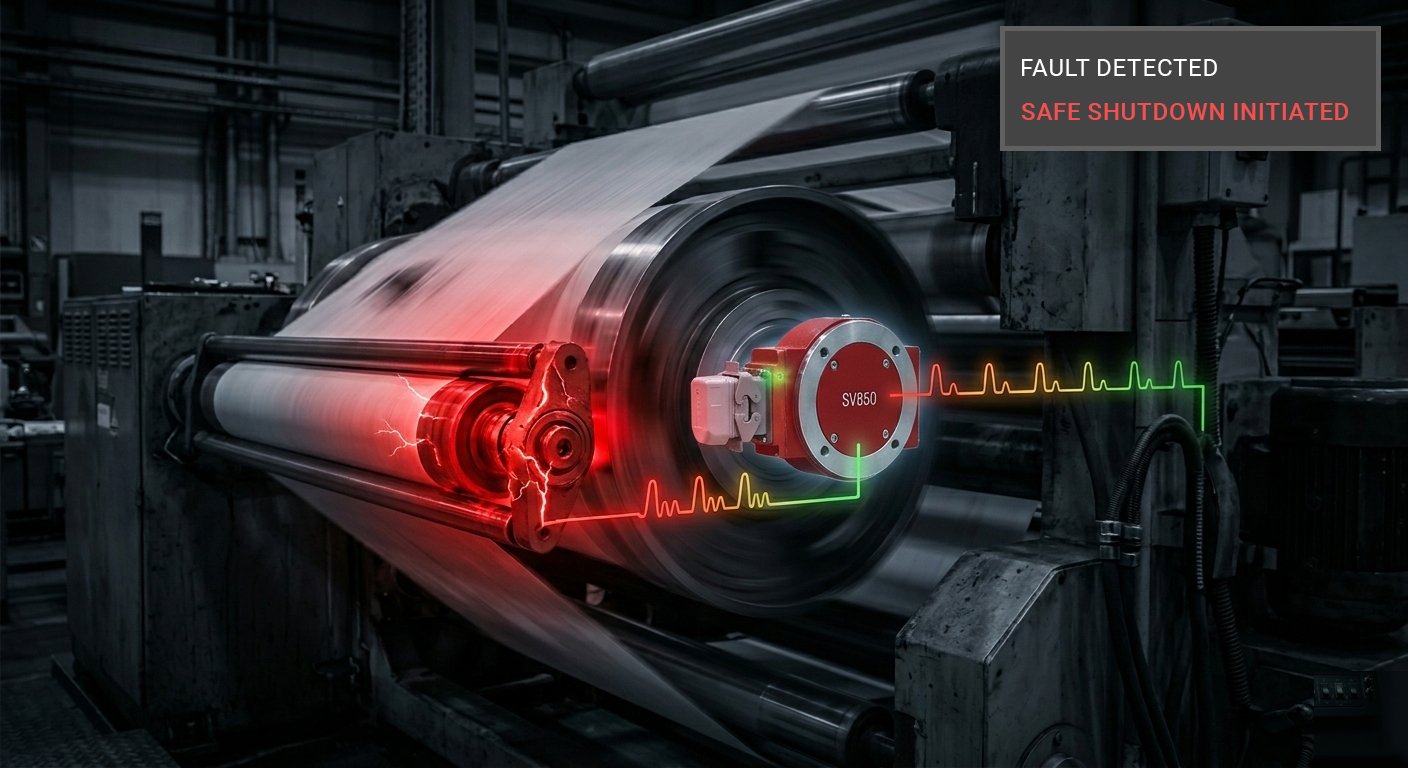
It only takes a split second.
A winder running at full speed. A slight overspeed condition goes undetected. A roll destabilizes. And suddenly, what was a routine production run turns into a safety incident, unplanned downtime, and thousands - if not millions - in losses.
This is the reality many paper mills are working hard to avoid. And it’s exactly why the concern for winder safety is on the rise.
The good news? Modern safety technologies, especially SIL-rated encoders, are changing the game. If you’re evaluating your next upgrade, understanding their role could make all the difference.
1. What are the biggest safety risks in paper mill winder operations?
Winders operate at high speeds with massive rolls under tension. The biggest risks include:
-
Overspeed conditions
-
Roll breakage or ejection
-
Reverse motion or uncontrolled rotation
-
Operator exposure during threading or maintenance
These aren’t just theoretical risks, they’re the exact scenarios that drive most winder safety upgrades today.
2. Why do traditional encoders fall short in modern winder safety systems?
Most legacy encoders were never designed for safety-critical applications. In paper mills, they struggle because:
- Optical designs fail in dust, moisture, and vibration
- No built in diagnostics to detect faults early
-
Single-point failures can go undetected
-
In fact, contamination alone can prevent optical encoders from reading signals correctly, leading to dangerous blind spots in your system.
That’s a major reason why many mills start exploring a winder upgrade.- 3. What is a SIL-rated encoder, and how does it improve winder safety?
- A SIL-rated encoder is designed to meet functional safety standards (IEC 61508) and deliver reliable motion feedback, even under fault conditions.
- In simple terms, it ensures:
-
Accurate speed and position monitoring
-
Fault detection before failure
-
Safe shutdown when limits are exceeded
- For winders, this means fewer surprises and safer operations.
- 4. What SIL level is required for paper mill winders, and why?
- Most winder applications typically require SIL 2-level protection, depending on risk assessments.
Why SIL 2?
-
It significantly reduces the probability of dangerous failures
-
It aligns with common industrial safety system architectures
-
It provides a practical balance between safety and cost
- Our Avtron Encoders model - the SV850 SAFETach™ - is specifically designed to meet IEC 61508 SIL 2 requirements, making it ideal for these applications.
- 5. How do SIL-rated encoders prevent overspeed and catastrophic failures?
- SIL-rated encoders continuously feed accurate speed and position data to safety systems.
This enables:
-
Safe Limited Speed (SLS): Prevents overspeed events
-
Safe Direction Monitoring: Stops unintended motion
-
Immediate fault detection: Triggers alarms or shutdowns
The result? You move from reactive troubleshooting to proactive risk prevention - a key driver behind any winder safety initiative.- 6. What features should you look for in a SIL-rated encoder for winder upgrades?
- Not all safety encoders are created equal. For a successful winder upgrade, look for:
- Resistance to dust, moisture, and vibration
- Built-in diagnostics and alarms
- No single point of failure
- Easy installation and maintenance
- Compatibility with existing motors and drives
- Dual output for additional redundancy or separate output to independent safety systems
-
This is exactly where our SV850 encoder stands out.- 7. How does upgrading to a SIL-rated encoder impact downtime and productivity?
- Here’s what plant managers care about most: uptime.
Upgrading to a SIL-rated encoder can:
-
Reduce nuisance trips caused by signal loss
-
Prevent unexpected failures
-
Enable predictive maintenance
For example, our SV850 encoder includes self-diagnostic LEDs and alarm outputs, helping teams identify issues before they stop production.
That’s not just safety, it’s measurable productivity gain.- 8. What is involved in upgrading a winder with a SIL-rated encoder?
- One of the biggest misconceptions is that a winder encoder upgrade is complex or time-consuming.
In reality, modern solutions are designed for simplicity:
-
Modular designs reduce installation time
-
Drop-in mounting for standard motors
-
Minimal alignment or adjustment required
The SV850, for instance, is built for quick installation with no complex gapping or shimming, making upgrades faster and less disruptive.- 9. How does the SV850 encoder compare to legacy systems?
- Here’s where things get interesting.
The SV850 SAFETach™ encoder is engineered specifically for harsh industrial environments like pulp and paper mills:
-
No bearings or wearing parts - eliminates mechanical failures
-
Magnetic sensing (no optics) - works through dirt and moisture
-
Fully sealed electronics - survives harsh mill conditions
-
Self-diagnostics and fault alerts - improves reliability
-
SIL 2 certification - ensures functional safety compliance
It’s also the world’s first safety-rated no-bearing encoder, designed to eliminate common failure modes entirely.
That’s a significant leap over traditional encoder technology.- 10. What ROI can paper mills expect from investing in SIL-rated encoders?
- A winder upgrade isn’t just a safety expense, it’s a business decision.
The ROI comes from:
-
Reduced downtime and maintenance costs
-
Fewer safety incidents and liabilities
-
Improved operator confidence and efficiency
-
Longer equipment life
- When you combine safety + reliability + uptime, the value becomes clear.
- Why Now is the Time for a Winder Upgrade
- If you’re evaluating winder safety, the encoder should be one of the first components you look at. Because at the end of the day:
-
Your safety system is only as reliable as its feedback
-
Your uptime depends on consistent, accurate signals
-
And your risk exposure is tied directly to how quickly faults are detected
The SV850 SIL-rated encoder isn’t just another component, it’s a purpose-built solution for modern paper mills that refuse to compromise on safety or performance.
If your current system is showing its age, this might be the smartest upgrade you make this year.


